
Play and exploration
Building, sorting, pretend play and simple problem-solving create opportunities to explore, make choices and learn through discovery.
Nurturing care, joyful learning and a strong start. Explore how ECCE and ECE connect play, relationships and everyday routines with a young child’s development.
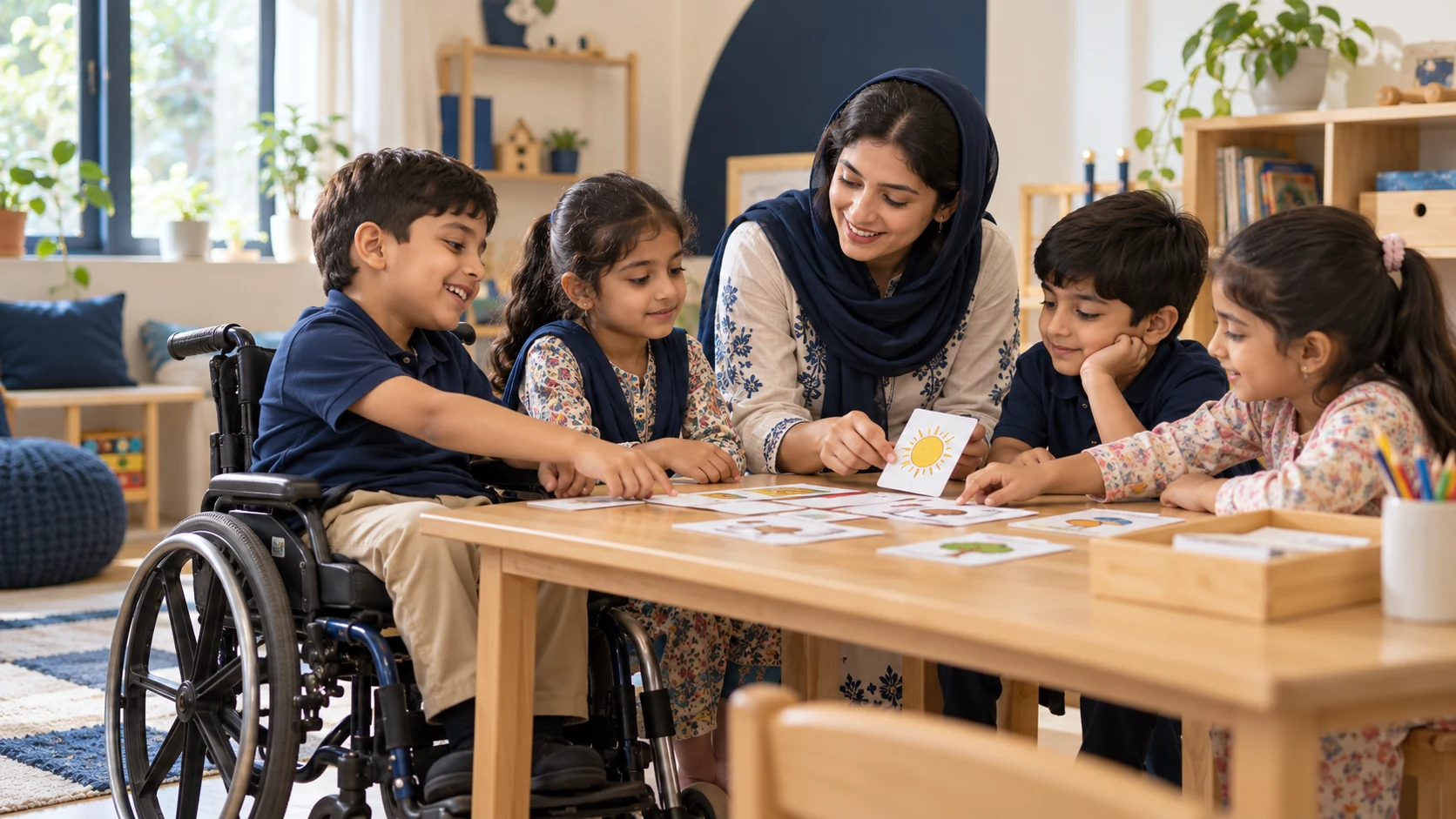
Early Childhood Care and Education (ECCE) brings nurturing care and early learning together to support a child’s physical, cognitive, language, social and emotional development.
Early Childhood Education (ECE) commonly describes learning experiences in the early years, including play, exploration, stories and interaction. The terms overlap. ECCE makes the importance of care, wellbeing and a safe, responsive environment explicit alongside education.
UNESCO describes early childhood as the period from birth to eight years. At ETKO, the suitable age group, class, timetable and support arrangements are discussed with parents after assessment.
Read UNESCO’s early childhood overview ↗Activities are selected around the child’s interests, developmental stage, communication and access needs. These examples show possible learning goals, with pace and support adjusted for each learner.
Building, sorting, pretend play and simple problem-solving create opportunities to explore, make choices and learn through discovery.
Songs, picture books and shared play encourage listening, expression and conversation through words, gestures, pictures or other useful communication supports.
Supported play helps children practise sharing attention, taking turns, recognising feelings, asking for help and developing trusting relationships.
Drawing, manipulating suitable toys and accessible movement games offer practice in coordination and participation, with adaptations where needed.
Stories, marks, patterns, matching, shapes and counting in play introduce early concepts in meaningful, manageable activities.
Predictable routines provide opportunities to practise handwashing, caring for belongings, making choices and participating in everyday tasks with appropriate help.
Settling into a group, following a short routine, communicating needs and gradually meeting new expectations can support the move toward classroom learning.
Parents share strengths, interests and priorities. Simple agreed activities connect learning at the centre with familiar routines at home.
Inclusive ECCE/ECE makes participation possible through accessible materials, flexible pacing and responsive adult support. Children can communicate and take part in different ways. Visual routines, adapted resources, manageable group activities and space for breaks can be considered around individual needs.
Parents’ observations help identify what makes learning comfortable and engaging. When a developmental concern needs more targeted support, the family and team can discuss an assessment and coordination with relevant education or therapy services.
Parents can support agreed goals through a short shared story, a favourite game or a familiar daily routine. The aim is enjoyable participation and useful learning at the child’s pace.
Visit ETKO in Gulzar-e-Hijri, District East, Karachi. Monday–Friday, 9 AM–2 PM. Call 021 34640406 or WhatsApp 0320-8317530. Scholarship enquiries are welcome.
ECCE/ECE is an early-learning and care approach. Targeted therapy addresses specific assessed needs. A child’s plan may connect the two, depending on the family’s goals and the professional assessment.
You can contact ETKO to discuss early learning, play or developmental concerns. Share any existing reports at assessment so the team can understand your child and discuss the next step.
The team discusses age, interests, developmental stage, communication and support needs with the family, alongside current class arrangements and availability.